What Is gRPC?
What Is gRPC?
gRPC is a high-performance, general-purpose open source RPC (Remote Procedure Call) framework developed by Google for fast and efficient communication between services.
It lets you call a function across a network as though it were a function in your own code. It standardizes remote function calls and enables fast, type-safe communication.
Unlike traditional REST communication, which commonly uses HTTP/1.1 and JSON, gRPC uses HTTP/2 and the binary Protocol Buffers (ProtoBuf) serialization format. This provides low latency, high throughput, and compact messages.
Service APIs are specified in .proto files. Servers and clients share the same interface definitions, and Stub code can be generated automatically for multiple programming languages. This improves development in polyglot environments and makes service boundaries easier to maintain.
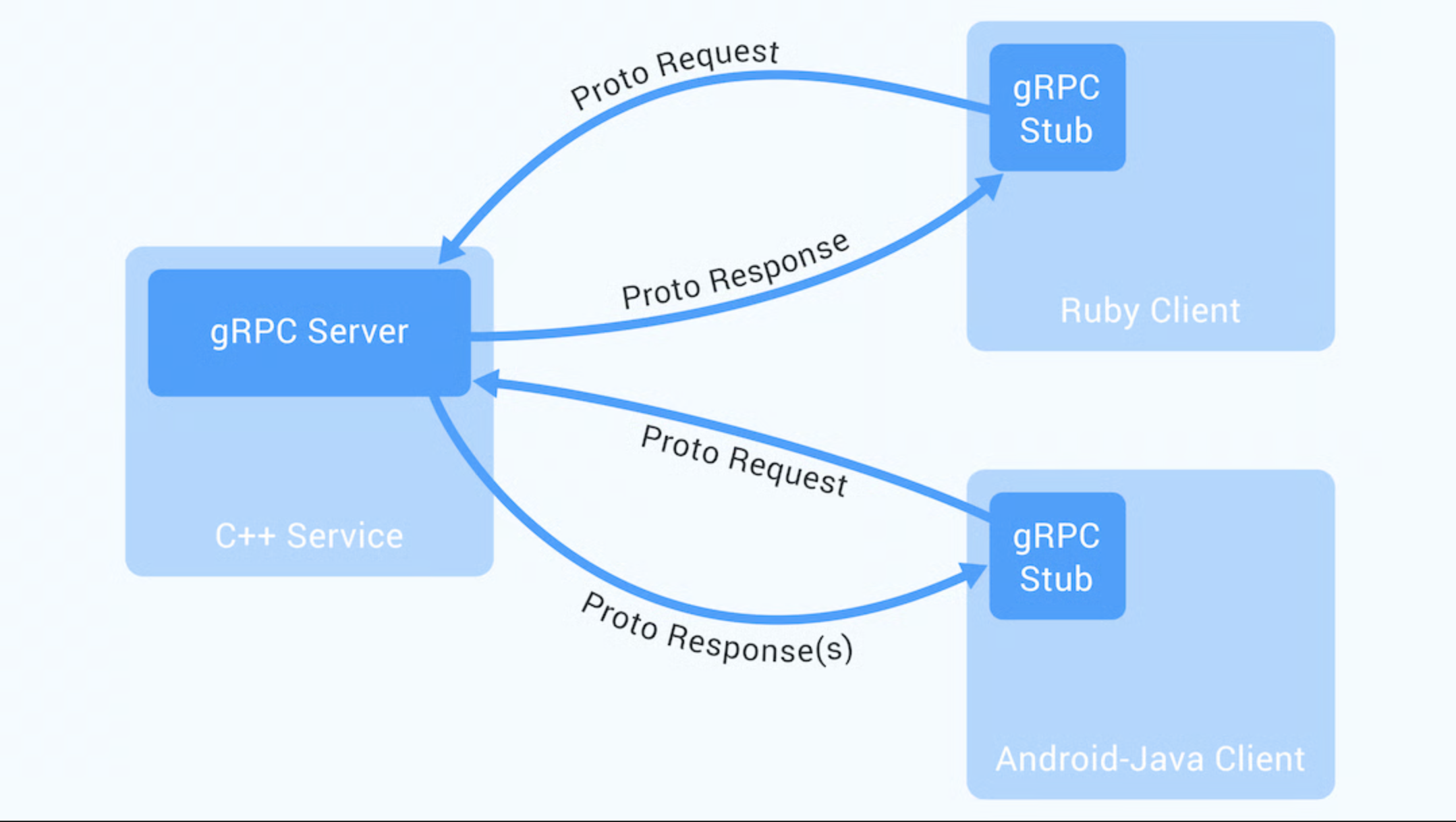 Source: https://appmaster.io/ko/blog/grpcneun-mueosibnigga
Core gRPC Elements
1. Based on Protocol Buffers
gRPC uses the binary Protocol Buffers format instead of JSON.
- Smaller and faster than JSON
- Based on an explicit schema in a protobuf file
- Automatically generates Stub code for clients and servers in each language
Example: hello.proto
service HelloService {
  rpc SayHello (HelloRequest) returns (HelloResponse);
}

message HelloRequest {
  string name = 1;
}

message HelloResponse {
  string message = 1;
}
2. HTTP/2 Communication
gRPC uses HTTP/2 internally, enabling:
- Multiplexing: multiple requests over one connection
- Server Push
- Header compression
- Streaming, including bidirectional streaming
This makes it faster and more efficient than REST for suitable workloads.
Four gRPC Communication Types
| Type | Description |
|---|---|
| Unary | One request and one response |
| Server Streaming | The server delivers multiple messages as a stream |
| Client Streaming | The client sends multiple messages and the server responds once |
| Bidirectional Streaming | The client and server exchange multiple messages concurrently |
Suitable for chat, real-time log processing, and streaming data processing.
Advantages and Disadvantages
Advantages
- Fast, lightweight communication through Protocol Buffers and HTTP/2
- Strong type safety with compile-time validation based on proto schemas
- Support for languages including Go, Java, Kotlin, Python, Rust, C#, Node, and Ruby
- Built-in bidirectional streaming
- Well suited to internal microservice communication
Disadvantages
- Difficult to call directly from browsers without gRPC-Web or WebAssembly
- Developers must understand proto authoring and compilation
- More difficult to debug than REST
When Should You Use gRPC?
Suitable Cases
- Internal microservice communication
- High-performance traffic
- Real-time streaming services
- Polyglot services, such as a Java server and Go client
- IoT, game servers, and real-time event processing
When REST Is Better
- APIs called directly by browsers
- Simple public APIs
- Cases that require human-readable formats such as JSON
gRPC vs REST
| Category | gRPC | REST |
|---|---|---|
| Communication protocol | HTTP/2 | Usually HTTP/1.1, although HTTP/2 is possible |
| Data format | Binary Protocol Buffers | Text formats such as JSON and XML |
| Speed | Very fast, compact, and efficient to parse | Relatively slower |
| Streaming | Full support, including bidirectional streaming | Limited; requires SSE or WebSocket separately |
| Interface definition | Types and schemas defined in .proto files |
No required schema; OpenAPI is recommended |
| Type safety | Compile-time validation | Often validated at runtime |
| Code generation | Automatic client and server Stub generation | Documentation through Swagger/OpenAPI; Stubs are optional |
| Ease of use | Browser calls require gRPC-Web | Directly usable from browsers and JavaScript |
| Human readability | Low due to binary format | High with readable JSON |
| Debugging | More difficult | Easier with curl and Postman |
| Security | Strong TLS and HTTP/2 combination | Standard TLS security |
| Best suited for | Internal microservices, high performance, real-time streaming | Public APIs, external integrations, browser-centric services |
| Language support | Official support for nearly every major language | Language-neutral when HTTP is supported |
| Summary of advantages | Fast, efficient, type-safe, strong streaming | Simple, easy to debug, highly compatible |
| Summary of disadvantages | Complex, limited browser accessibility | Lower performance, weaker type safety |
Conclusion
- gRPC: Best for internal communication, high performance, and streaming.
- REST: Best for browsers, public APIs, and convenient debugging.