Linux Kernel | What Are an OS and Kernel?
What Are Linux and an OS?
An OS (Operating System) is software that mainly manages hardware and lets software access hardware. Linux is an OS and is mainly composed of the kernel, system libraries, and system utilities.
What Is the Linux Kernel?
The Linux kernel is the core part of the OS. It provides fundamental functions for controlling hardware and application software, such as memory management, file systems, process management, and device control. Android is built on top of the Linux kernel.
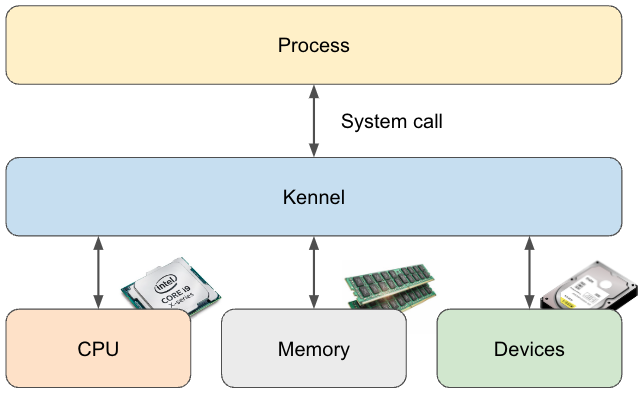
Kernel functions include managing hardware resources such as CPU, memory, and storage, and abstracting access from software to hardware and resources.
Hardware
Hardware refers to physical devices that process work in a computer. Major examples include CPU, registers, cache memory, main memory, storage, NICs, mouse, keyboard, and display.
CPU Operating Modes
CPU operating modes include kernel mode and user mode.
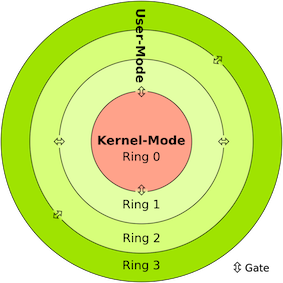
Source: https://ja.wikipedia.org/wiki/CPU%E3%83%A2%E3%83%BC%E3%83%89
Kernel mode has no hardware access restrictions and is used by the kernel. User mode has restrictions and is used by software other than the kernel.
Software
Software is a collection of processing logic and data. It gives logical meaning to physical hardware. Examples include programs, processes, threads, applications, modules, libraries, packages, middleware, kernel, system libraries, system utilities, and the OS.
System Calls
A system call is a process by which a process invokes kernel functionality. It is used when a process accesses hardware resources such as CPU, memory, or storage because user-mode processes cannot directly access those resources.
$ strace echo hello
Hardware Resource Abstraction
Hardware resource abstraction means that the OS absorbs differences between hardware. A program can write data with the write() system call without needing to know whether the target is an SSD from one vendor, another vendor’s SSD, or a USB memory device.
Hardware Resource Management
Kernel resource management determines how much hardware resource a process can use, in what order resources are used, and whether a process must wait when another process is using a resource.
Kernel Functions
Representative kernel functions include process management for CPU allocation, memory management for main memory allocation, storage management and file systems for reading and writing data, and I/O device management.