Web
What Is the Web?
The term most often encountered when using the Internet is probably the World Wide Web (WWW). The web is also called WWW, using only the first letters of the English words, or simply Web. The web symbolizes a web, meaning a spider web.
Because the web is implemented graphically, one of its greatest advantages is convenient information search. It can display text and graphics on the screen at the same time, and thanks to its excellent user interface, text, graphics, sound, video, and similar content can be handled easily in a browser.
Web Browser
A web browser is a client program that allows users to view hypertext documents on a web server using the Internet. It can process not only text but also multimedia data through hypermedia functions. When users want audio or video information, it can load and execute the required programs to handle various resources on the web.
Basic functions provided by a web browser include opening web pages, providing a list of recently visited URLs (Uniform Resource Locators), remembering and managing frequently visited URLs, and saving and printing web pages. Without a web browser, even if you are connected to the Internet, you cannot view homepages on the Internet.
Types of Web Browsers
- Google Chrome.
- Mozilla Firefox.
- Chromium Microsoft Edge.
- Opera browser
- Vivaldi browser
- Naver Whale
- Brave browser
How the Web Works
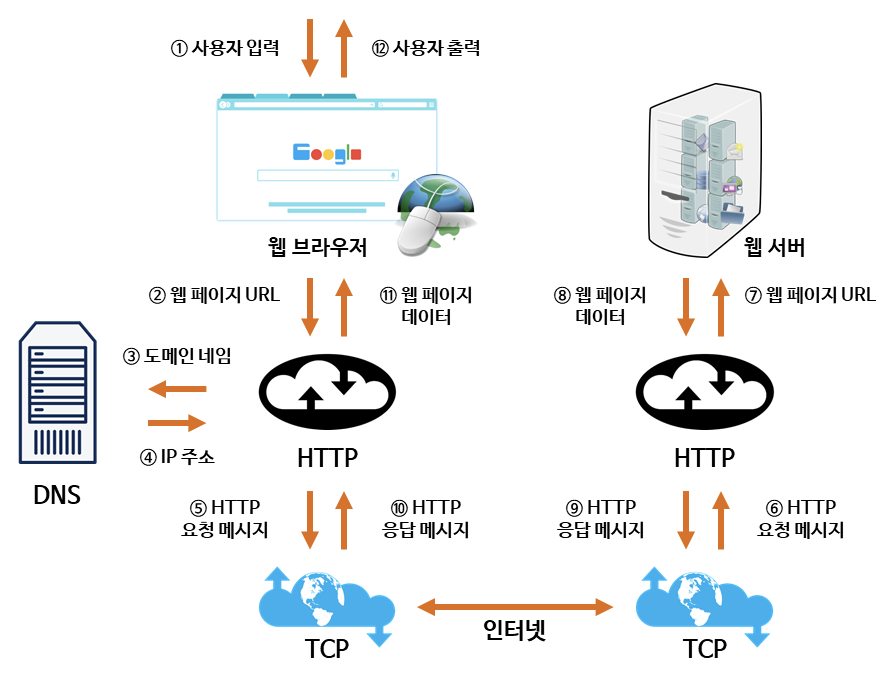
Image source: http://tcpschool.com/webbasic/works
- The user enters a URL in the browser.
- The browser finds the server’s IP address through DNS.
- It creates an HTTP request message using the HTTP protocol.
- It sends the HTTP request message through a TCP/IP connection.
- The server creates an HTTP response message using the HTTP protocol.
- It sends the response to the requesting computer through a TCP/IP connection.
- The arrived HTTP response message is returned as web page data and rendered by the web browser so the user can view it.
International Standards for Web Accessibility
- Web standards designed to improve web accessibility refer to commonly used technologies and rules.
- The W3C (World Wide Web Consortium) was established to define web standards.
- Web standards define HTML as the structure language, CSS as the presentation language, and Script as the behavior language.