Graph Database Overview
Changes in database technology
Changes in database technology from a historical perspective that show how graph thinking emerged.
- 1960s: hierarchical
- 1980s: relational
- 2000s: NoSQL
- 2020s: graph thinking
Introduction to graph databases
Graph data is based on mathematical graph theory. It consists of points (Node/Vertex) that represent data for individual objects, groups (Label) of objects with similar characteristics, and lines (Edge) that represent relationships between objects.
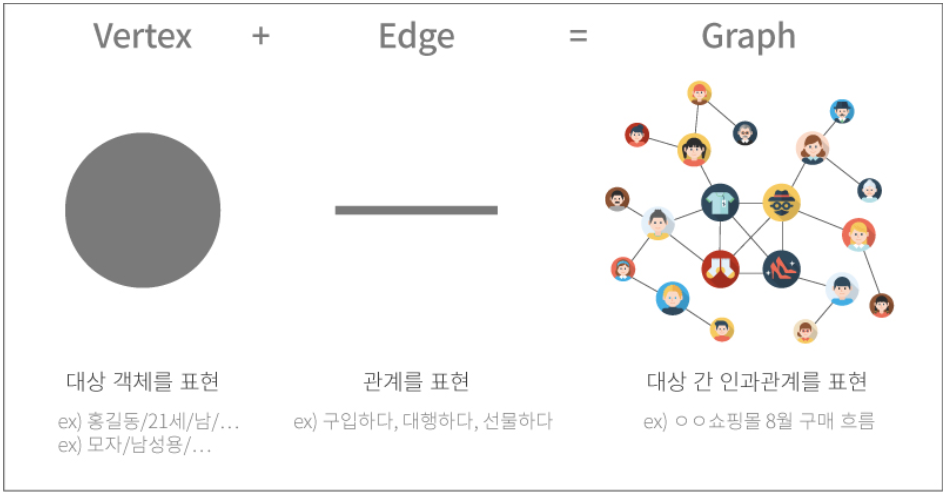
The concept of a graph that shows human relationships with points and lines
Graph theory terms
Let’s look at terms used in graph theory.
Types of graphs
| Term | Description |
|---|---|
| Graph | A data structure that organizes relationships between things as Nodes and Edges |
| Directed Graph | A graph whose Edges between Nodes have direction |
| Undirected Graph | A graph whose Edges between Nodes have no direction, where the relationship between two Nodes is bidirectional |
| Weighted Graph | A graph whose Edges between Nodes have weights |
| Unweighted Graph | A graph whose Edges between Nodes have no weights, where all Edges have equal strength |
Resources in Graph
| Term | Description |
|---|---|
| Node | An entity in ontology |
| Edge | A relation in ontology |
| Properties | Information related to Nodes and Edges |
| Label | A Role in ontology |
What is ontology?
An ontology is a model that represents, in a conceptual and computer-processable form, what people have agreed on through discussion about what they see, hear, feel, and think about the world. It explicitly defines concept types and usage constraints. Source: [Wiki](https://ko.wikipedia.org/wiki/%EC%98%A8%ED%86%A8%EB%A1%9C%EC%A7%80)
Properties on Node: Node properties
| Term | Description |
|---|---|
| title | Node name |
| caption | Node description |
:Properties on Edge: Edge properties
| Term | Description |
|---|---|
| Directionality | Connection direction |
| Weight | Connection weight |
Data collection
| Term | Description |
|---|---|
| Node List | A list of all Nodes |
| Edge List | A list of all Edges |
| Adjacency Matrix | A two-dimensional table of all Nodes x all Nodes. Each entry represents the Edge state numerically. Example: -1 means no connection, 1 to N means Weight. |
| Neighbors | A list of Nodes adjacent to a Node |
References
- [Useful IT Notes] What is a graph database? (Graph Database) - Part 1
- 01-1 What is a graph database? | WiKiDocs